
Scientists taught a cockatoo named Figaro to combine tools and “golf” for reward

Figaro the cockatoo displays his “primate level” combination tool-using skills by playing a cockatoo version of “golf,” and choosing the correct hole for a cashew reward. Two other cockatoos figured out different tool-using techniques to achieve the same result. (Goffin Lab)

Several years ago, we introduced Ars readers to Figaro, a precocious male Goffin’s cockatoo kept in captivity and cared for by scientists in the “Goffin lab” at the University of Veterinary Medicine in Vienna. Figaro showed a surprising ability to manipulate single tools to maneuver a tasty nut out of a box. Other cockatoos who repeatedly watched Figaro’s performance were also able to do so. Now, Figaro and his cockatoo cronies are back, having learned how to combine tools—in this case, a stick and a ball—to play a rudimentary form of “golf,” according to a new paper published in the journal Scientific Reports.

As Ars’ Science Editor John Timmer explained in 2012, tool use was once thought to be one of the defining features of humans, but examples of it were eventually observed in primates and other mammals. Then birds were observed using tools in the wild, although this behavior was limited to corvids (crows and jays). Parrots, by contrast, have mostly been noted for their linguistic skills, and there has only been limited evidence that they use anything resembling a tool in the wild. Primarily, they seem to use external objects to position nuts while feeding.

Then along came Figaro. Figaro was playing with a stone one day in the Goffin Lab at the University of Vienna’s Department of Cognitive Biology, led by Alice Auersperg. He accidentally dropped the stone behind a metal divider.

Read 14 remaining paragraphs | Comments
Intel’s strategy for outflanking Arm takes shape with bet on RISC-V

Intel’s strategy for outflanking Arm takes shape with bet on RISC-V

Enlarge (credit: ony Avelar/Bloomberg)

Many of Intel’s current woes can be traced to the fact that the company was left out of the iPhone. Whether Intel passed on the opportunity or couldn’t meet the spec is by now a moot point, but missing out on the smartphone revolution—and its billions of chips—played no small part in the company falling behind the leading edge.

Now, Intel is ponying up $1 billion in an attempt to avoid repeating history.

The company announced an “innovation fund” this week that places bets on a couple of key technologies, chief among them RISC-V, a free, open source instruction set that shows promise in low-power and embedded systems, markets that are expected to grow significantly over the next several years.

Read 10 remaining paragraphs | Comments

Five seconds, 59 megajoules: A new record for tokamak fusion

The interior of JET, configured as a scale model for ITER, overlaid with an image of a plasma present in the tokamak during experiments.

Enlarge / The interior of JET, configured as a scale model for ITER, overlaid with an image of a plasma present in the tokamak during experiments. (credit: EUROfusion)

On Wednesday, the EUROfusion consortium announced that the Joint European Torus (JET), located near Oxford in the UK, had set a new record for released energy. Over the course of a five-second “pulse,” 59 megajoules of energy were released, double the previous record for tokamak fusion set at JET in 1997.

Despite the impressive numbers, the results are still well short of the break-even point where the fusion energy released would match the energy input required to trigger the fusion. Still, the work provides an important validation of the approach being taken at the next major fusion project, the International Thermonuclear Experimental Reactor, or ITER.

Two ways to fuse

Fusion takes place when atomic nuclei are brought close enough together that they merge, creating a heavier element. It’s the process that powers stars, and it could produce vast amounts of energy from small amounts of hydrogen isotopes if we could reproduce the temperatures and pressures found in stars here on Earth. So far, we’ve taken two main approaches to the process.

Read 8 remaining paragraphs | Comments
Namco Bandai promises Elden Ring is secure following Dark Souls exploit

Promotional screenshot for upcoming video game.

Enlarge / In Elden Ring, you get a horse. (credit: Bandai Namco)

Last month, publisher Namco Bandai took down its online player-versus-player servers for all PC Dark Souls games after players found a serious vulnerability that allowed for remote execution of malicious code on an opponent’s computer. While a Reddit user who publicly identified that issue said the exploit would also work on Namco Bandai’s upcoming Elden Ring, the publisher is now assuring players that the highly anticipated title will be protected.

“We have extended the investigation to Elden Ring… and have made sure the necessary security measures are in place for this title on all target platforms,” Namco Bandai wrote in a tweet Wednesday morning.

The wording of that statement suggests that Elden Ring‘s online services will launch as expected when the game is released on February 25. That’s important for players looking forward to online co-op gameplay, competitive multiplayer battles/invasions, and even basic message support between player worlds, as seen in Dark Souls.

Read 3 remaining paragraphs | Comments
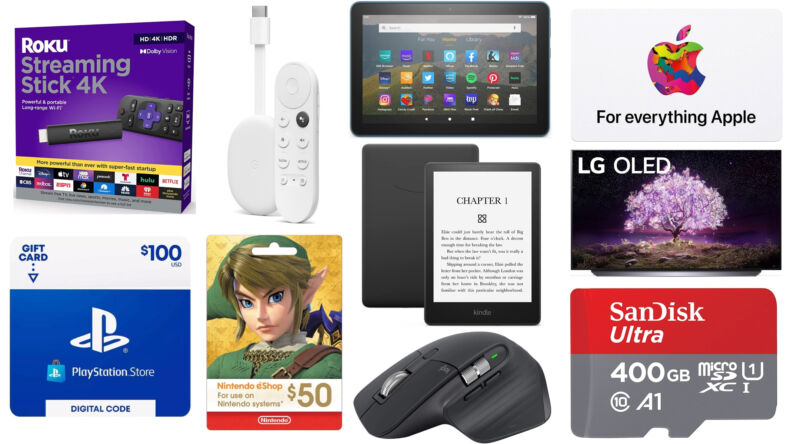
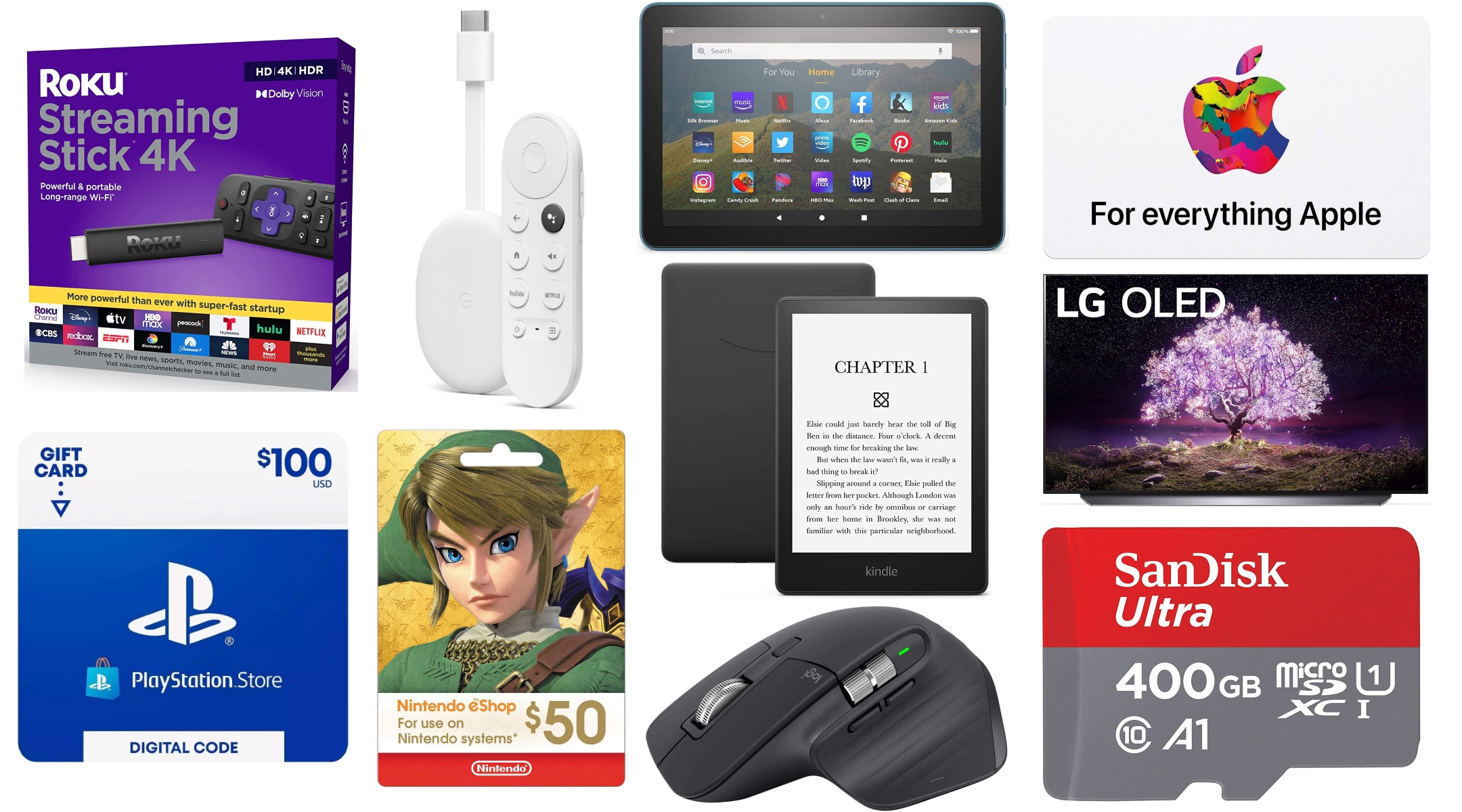
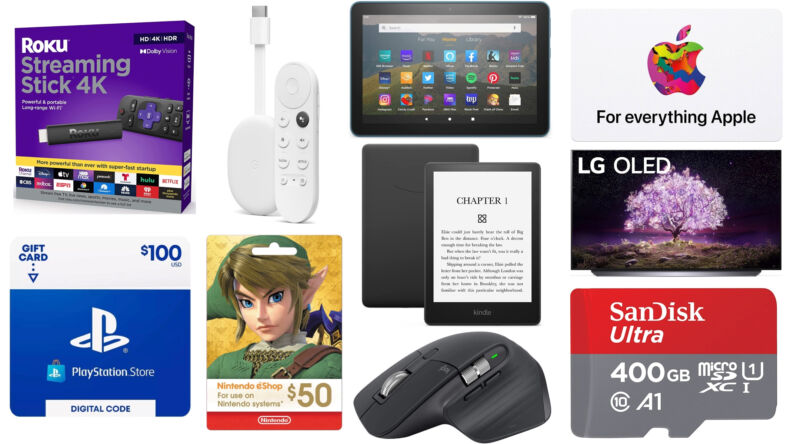
Today’s best deals: Chromecast, Amazon Fire tablets, Kindle Paperwhite, and more

Today’s best deals: Chromecast, Amazon Fire tablets, Kindle Paperwhite, and more

Enlarge (credit: Ars Technica)

It’s time for another Dealmaster. Our latest roundup of the best deals from around the web includes a nice discount on Google’s Chromecast with Google TV, as the 4K media streamer is currently down to $40 at various retailers. This discount has popped up a few times in the past, but it matches the deal price we saw around Black Friday and comes in $10 below Google’s MSRP. We’ve only seen the device available for less once, but that deal also required you to sign up for Sling TV service.

In any event, the latest Chromecast is the top pick in our guide to the best streaming sticks. Its interface is better at organizing and surfacing content you might actually like than alternatives from Amazon and Roku, it supports all the requisite apps and HDR standards (along with Dolby Atmos), and its remote is compact with a sensible layout. Recent reports suggest that Google may launch a successor later this year, but if you need a new streaming player today, this is a good price for what we think is still the best value in this market. If you prefer a less personalized approach from your media streamer, though, note that Roku’s Streaming Stick 4K is currently on sale for $30; its UI is far more basic, but it performs just as well.

Besides that, our roundup has the return of a few all-time low prices on Amazon’s Fire HD 8 tablets, which remain worth considering for those who want a competent tablet for the lowest price possible. Amazon has discounted its latest set of Kindle Paperwhite e-readers as well: the standard model, which our review called the best option for most people, is now $30 off at $110. That’s within $5 of that device’s lowest-ever price. We also have a couple of sweeping “buy two, get one free” sales at Amazon and Target, a “buy one, get one 15 percent off” sale on gaming digital gift cards at the latter, plus deals on LG’s C1 OLED TV, a few first-party Nintendo Switch games, and the highly recommended Logitech MX Master 3, among items. You can see our full curated list below.

Read 1 remaining paragraphs | Comments

SpaceX loses up to 40 satellites to geomagnetic storm after Starlink launch

Illustration of Earth being hit by a coronal mass ejection from the Sun.

Enlarge / Illustration of a coronal mass ejection impacting the Earth’s atmosphere. These events can cause geomagnetic storms. (credit: Getty Images | Mark Garlick/Science Photo Library)

SpaceX had to ditch most of its latest batch of Starlink satellites because they were disrupted by a geomagnetic storm after being launched from the Falcon 9 rocket. Up to 40 of the 49 satellites will re-enter the atmosphere or have already done so because they were unable to reach their intended orbits.

In an update posted yesterday, SpaceX said that on February 3, the Falcon 9’s second stage deployed 49 “satellites into their intended orbit, with a perigee of approximately 210 kilometers above Earth, and each satellite achieved controlled flight.” SpaceX initially deploys satellites into lower altitudes than they ultimately orbit in “so that in the very rare case any satellite does not pass initial system checkouts, it will quickly be deorbited by atmospheric drag,” the company said. SpaceX has licenses for altitudes of 540 km to 570 km and 335 km to 346 km.

Last week’s geomagnetic storm hit a day after launch, SpaceX explained:

Read 3 remaining paragraphs | Comments

The Galaxy S22 line is official for $800-$1,200, ships February 25

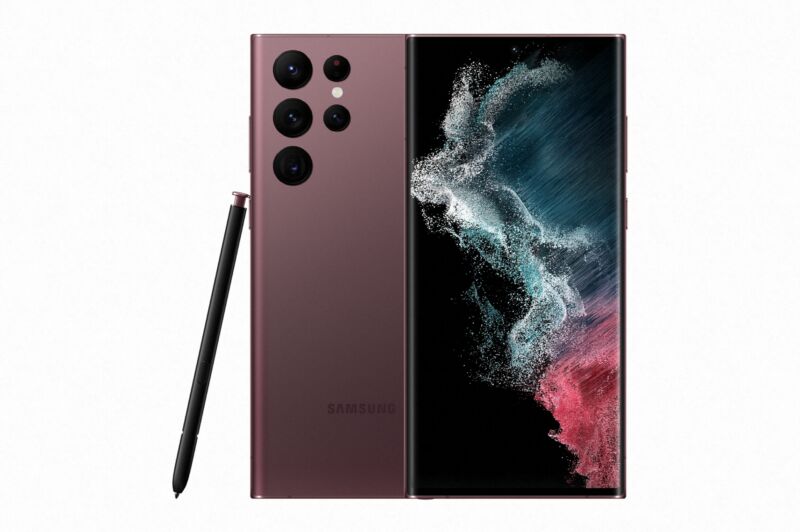
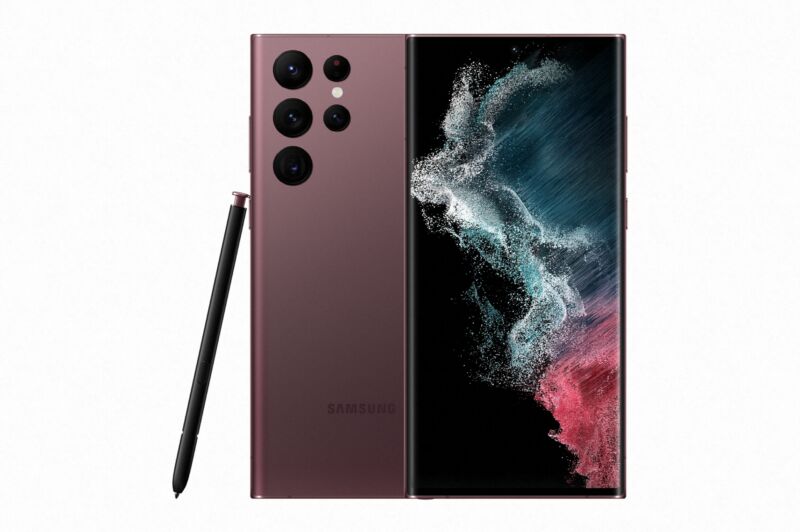
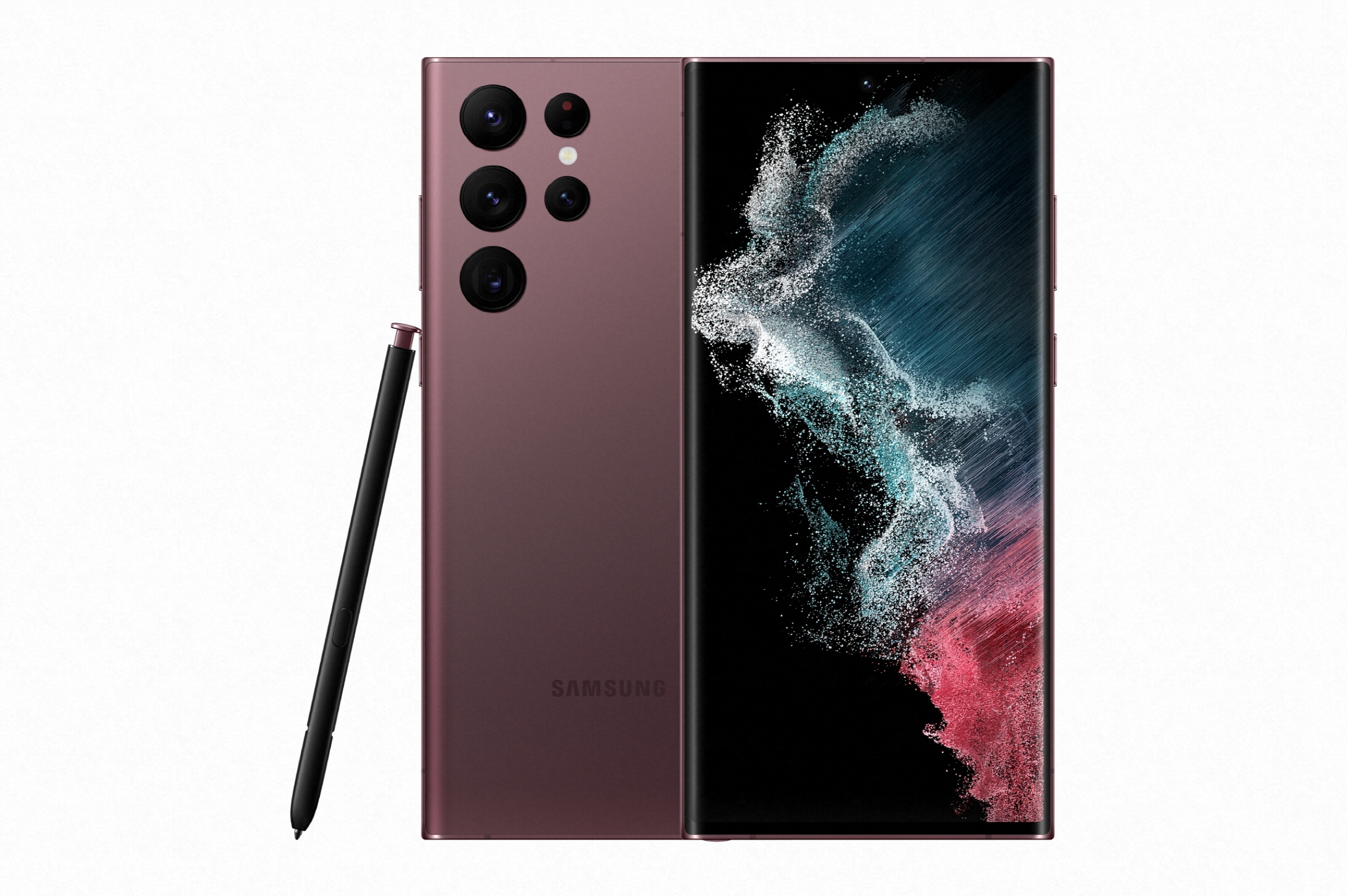
The Galaxy S22 Ultra. It has a pen.

Enlarge / The Galaxy S22 Ultra. It has a pen. (credit: Samsung)

February is officially new phone season, and Samsung is kicking things off with the launch of the Galaxy S22. After all the leaks, the big news items today are the prices and release date. The phones cost the same as last year$799.99 for the S22, $999.99 for the S22+, and $1,199.99 for the Galaxy S22 Ultra. Preorders for the phones start today, and the ship date is February 25.

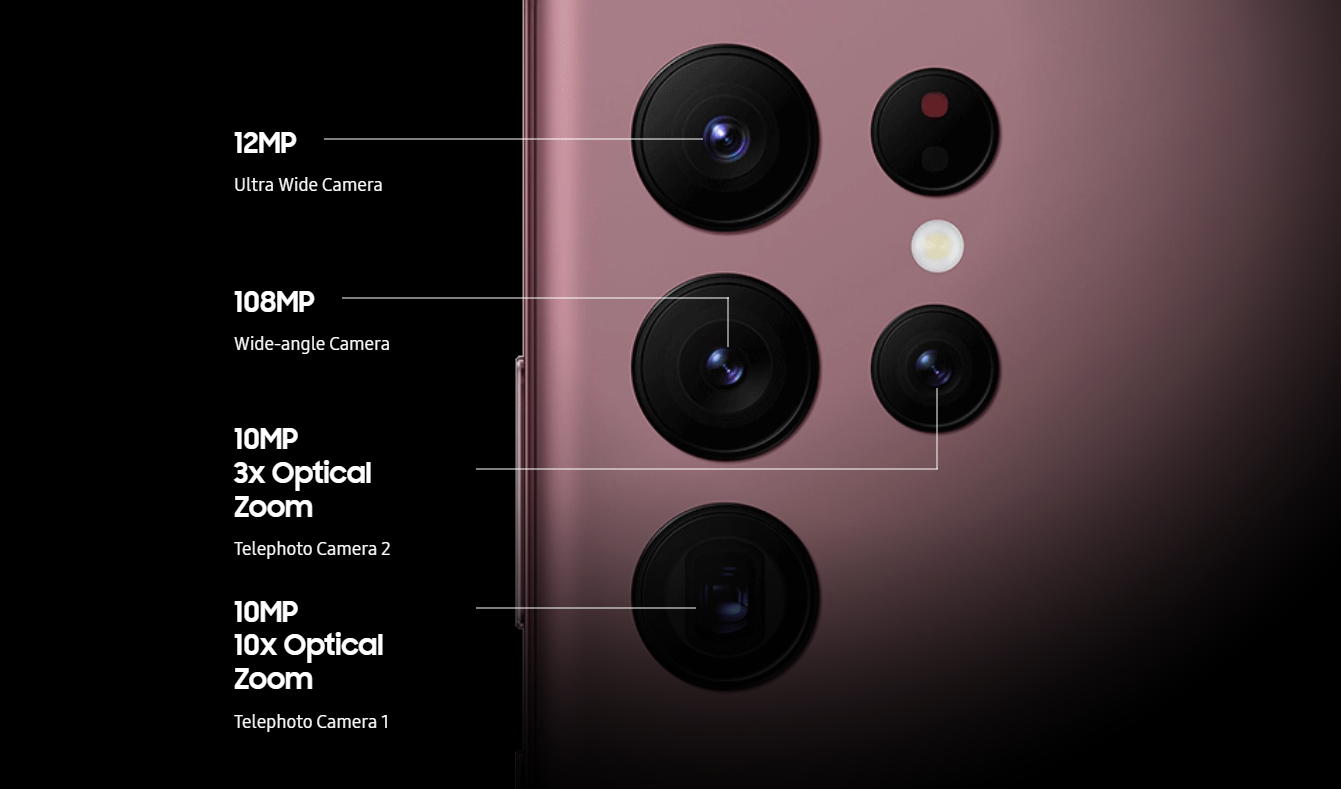
On the base and “Plus” models, there aren’t many design changes to talk about. The Ultra model is getting a big change, though—it’s basically turning into the Galaxy Note. Samsung killed the stylus-equipped Note line in 2020, choosing instead to focus on foldable smartphones rather than launching two nearly identical slab smartphones every year. The Galaxy S22 Ultra isn’t called a Note, but it’s picking up the design and features of one, with taller corners and an integrated S-Pen. The Ultra model also has a new look for the camera bump, which goes with individual lenses instead of last year’s big corner bump.

Figuring out the differences from year to year is mostly a game of millimeters. The base-model S22 is a bit smaller than last year’s version; it has a 6.1-inch, 120 Hz, 2340×1080 display and a 146×70.6×7.6 mm body (down from 6.2 inches and 151.7×71.2×7.9 mm from last year). It also has a smaller battery—3700 mAh versus the 4000 mAh battery of the S21. The phone has 8GB of RAM and 128 or 256GB of storage. You get three rear cameras on the base and plus models: a 50 MP main camera, a 12 MP ultra-wide, and a 10 MP 3X optical zoom camera. There’s a 10 MP front camera.

Read 5 remaining paragraphs | Comments

Find the soul