

How to become a world-dominating supervillain for a measly $55 billion

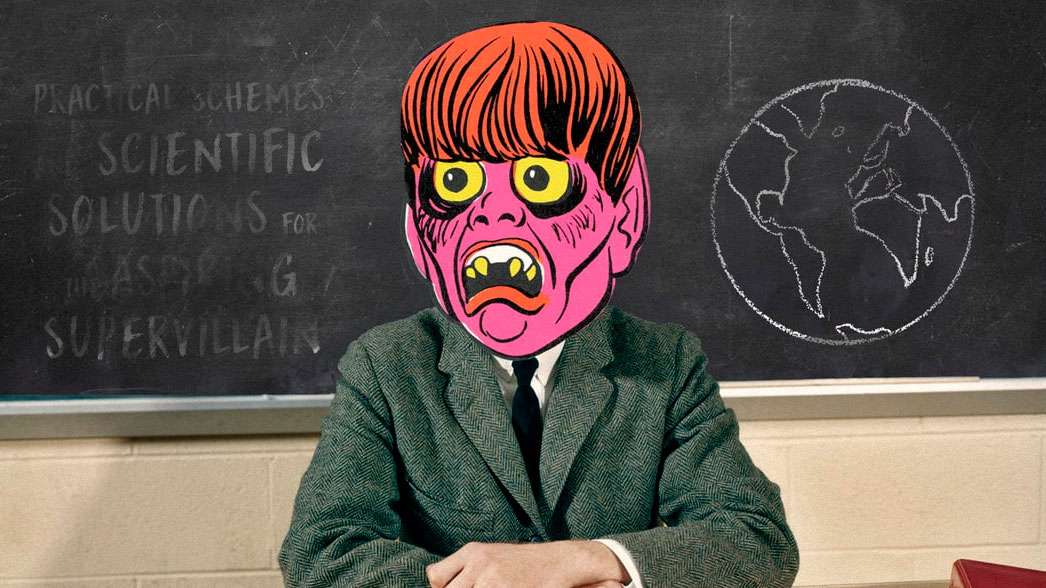
Ryan North, creator of <em>Dinosaur Comics</em>, offers a step-by-step guide to becoming the next Lex Luthor in his new book, <em>How To Take Over the World: Practical Schemes and Scientific Solutions for the Aspiring Supervillain</em>.

Enlarge / Ryan North, creator of Dinosaur Comics, offers a step-by-step guide to becoming the next Lex Luthor in his new book, How To Take Over the World: Practical Schemes and Scientific Solutions for the Aspiring Supervillain. (credit: Ryan North, tweaked by Aurich Lawson)

Are you a fan of superhero comics who identifies more with the Big Bad? Do you dream of riding around on your own cloned dinosaur and kicking back after a long day’s evil-doing in your floating, secret supervillain base? Good news: Ryan North has got you covered. He’s the author of a new book called How to Take Over the World: Practical Schemes and Scientific Solutions for the Aspiring Supervillain, and there’s frankly nobody better qualified to guide the reader through a step-by-step process toward world domination.

North is something of a webcomic pioneer, having started Dinosaur Comics (aka Qwantz) way back in 2003. The strip’s signature six panels are the same every time, consisting of simple dinosaur clip art that North found on a CD; only the text changes. T-Rex is the main character, with Utahraptor appearing as a comic foil in the fourth and fifth panels. A third dinosaur, Dromiceiomimus, is featured in the third panel. North has said he did it this way because he can’t draw. It’s been a staple of nerdy webcomics ever since.

That early success led to North becoming the writer for several Marvel Comics series, most notably the Eisner Award-winning The Unbeatable Squirrel Girl (a personal favorite) and Jughead. It was only a matter of time before he wrote his first popular science book: the delightfully irreverent (and best-selling) How to Invent Everything: A Survival Guide for the Stranded Time Traveler. In each chapter, North demonstrated how the reader could invent any number of modern conveniences from first principles, as well as answering the burning question of whether it’s possible to tame a giant wombat.

Read 30 remaining paragraphs | Comments

AMD announces FSR upscaling 2.0, promises big, hardware-agnostic gains

AMD announces FSR upscaling 2.0, promises big, hardware-agnostic gains

Enlarge (credit: AMD)

When the PC industry’s two biggest graphics card manufacturers aren’t battling over benchmarks or chip shortage woes, they’ve been fighting over a different sales pitch: boosting performance for older GPUs. And while Nvidia has largely won that war, that has come with an asterisk of a proprietary performance-boosting system, DLSS, that requires relatively recent Nvidia hardware.

AMD’s first major retaliatory blow came in the form of 2020’s FidelityFX Super Resolution, but this open source, hardware-agnostic option has thus far proven inadequate. And AMD finally seems ready to admit as much in its rollout of FSR 2.0, which debuted in limited fashion on Wednesday ahead of a wider Game Developers Conference reveal next week and a formal rollout in video games starting “Q2 2022.”

It’s time for temporal solutions

Both FSR and DLSS function in modern games as pixel upscalers. In both cases, games run at a lower base resolution of pixels, and then, whichever system is active processes and reconstructs the resulting imagery at higher pixel counts. This can include intelligent anti-aliasing (to reduce “stair-stepping” of diagonal lines), blurring, or even wholly redrawn pixels. Ultimately, the dream is that these systems can wisely convert games running at 1440p or even 1080p to something nearly identical to a full 4K signal.

Read 7 remaining paragraphs | Comments

Trickbot is using MikroTik routers to ply its trade. Now we know why

Trickbot is using MikroTik routers to ply its trade. Now we know why

Enlarge (credit: Getty Images)

For years, malicious hackers have been hacking large fleets of MikroTik routers and conscripting them into Trickbot, one of the Internet’s most destructive botnets. Now, Microsoft has finally figured out why and how the devices are being put to use.

Trickbot came to light in 2016 as a trojan for stealing account passwords for use in bank fraud. Since then, it has mushroomed into one of the Internet’s most aggressive threat platforms, thanks to its highly modular, multi-stage malware framework that provides a full suite of tools that are used to install ransomware and other forms of malware from other hacking groups.

The malware driving Trickbot is notable for its advanced capabilities. It excels at gaining powerful administrator privileges, spreading rapidly from computer to computer in networks, and performing reconnaissance that identifies infected computers belonging to high-value targets. It often uses readily available software like Mimikatz or exploits like EternalBlue stolen from the National Security Agency.

Read 12 remaining paragraphs | Comments

Largest Aztec temple was decorated with over 100 starfish

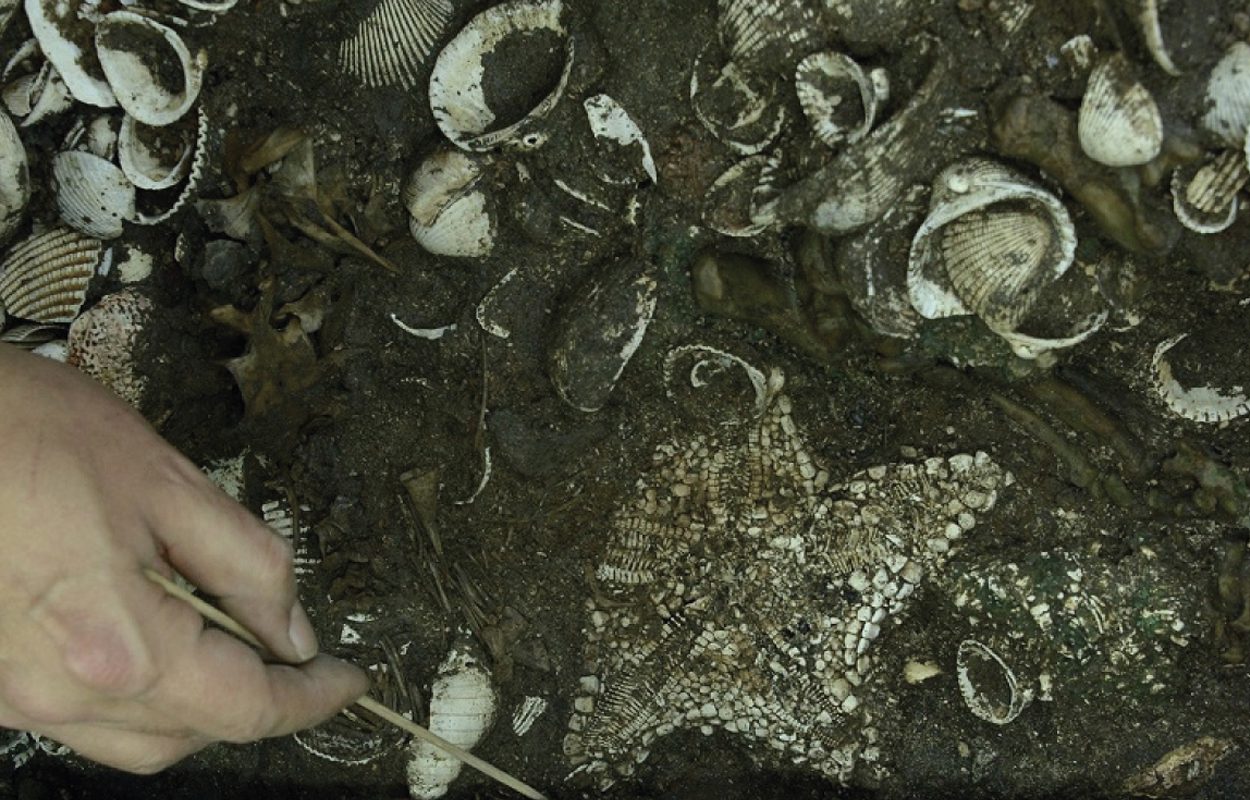
This imprint preserves details of the internal structure of the starfish, as well as its overall shape. It's one of 164 starfish recently unearthed at the Templo Mayor site in Mexico City.

Enlarge / This imprint preserves details of the internal structure of the starfish, as well as its overall shape. It’s one of 164 starfish recently unearthed at the Templo Mayor site in Mexico City. (credit: INAH)

Aztec priests at Tenochtitlán offered a whole galaxy of starfish to the war god Huitzilopochtli 700 years ago, along with a trove of other objects from the distant edges of the Aztec Empire. Archaeologists from Mexico’s National Institute of Anthropology and History (INAH) recently unearthed the offering on the site of the Templo Mayor, the main temple in the Aztec capital of Tenochtitlán, in what is now Mexico City.

Ahuizotl, coast to coast

The offering included 164 starfish from a species called Nidorella armata, known less formally as the chocolate chip starfish because it’s mostly the color of cookie dough, but it has dark spots. (It shares the nickname with the other chocolate chip sea star, Protoreaster nodosus, which provides an excellent argument in favor of scientific names.) Nidorella armata lives along the Pacific coastline from Mexico south to Peru, where it hangs out on shallow-water reefs of rock and coral.

For Tenochtitlán, the nearest source of chocolate chip starfish would have been nearly 300 kilometers away from the Aztec capital. Chunks of coral found in the same offering came from about the same distance away but in roughly the opposite direction—the western end of the Gulf of Mexico. At the time, these items came from the farthest eastern and western edges of the Aztec Empire, places that the Aztec ruler Ahuizotl had only recently conquered.

Read 14 remaining paragraphs | Comments

Netflix fights password-sharing with test of $3 “Extra Member” fee

Woman relaxing on the couch and holding a TV remote control while watching videos on demand.

Enlarge (credit: Getty Images | cyano66)

Netflix will soon charge an extra fee for sharing accounts with people in other households in the company’s latest attempt to reduce the password-sharing that has been common among Netflix users for years. The fee will roll out in Chile, Costa Rica, and Peru “over the next few weeks” and potentially go worldwide at a later date.

“Members on our Standard and Premium plans will be able to add sub accounts for up to two people they don’t live with—each with their own profile, personalized recommendations, login and password—at a lower price: 2,380 CLP in Chile, 2.99 USD in Costa Rica, and 7.9 PEN in Peru,” Netflix said in an announcement yesterday. Based on current conversion rates, 2,380 CLP is about $2.98 USD and 7.9 PEN is about $2.12 USD.

The new fee will be paired with the ability for users to transfer profile information including their viewing history and watchlist to a new account or an Extra Member account. After rolling out the fee and profile transfers in Chile, Costa Rica, and Peru, Netflix will “be working to understand the utility of these two features for members in these three countries before making changes anywhere else in the world,” the company said.

Read 5 remaining paragraphs | Comments

Google Play Store will promote tablet apps with “quality” ranking

Promotional image uses cartoonish computing devices.

Enlarge / A mockup of Android 12L running on different types and sizes of devices. (credit: Google)

Google wants to make 2022 the year of Android tablets, and after launching a tablet-focused Android 12L update, staffing up an Android tablet division, and shipping one or two tablet apps, the company is now giving the Play Store some tablet love. The goal is to make it easier for tablet users to find actual tablet apps rather than stretched-out phone apps.

First up are “ranking and profitability changes” for the Play Store. Google says, “In the coming months, we’ll be updating our featuring and ranking logic in Play on large-screen devices to prioritize high-quality apps and games.” The rankings will “affect how apps are surfaced in search results and recommendations on the homepage, with the goal of helping users find the apps that are best optimized for their device.”

To get better rankings, an app needs to be “high quality.” The qualifications for this designation are laid out in detail on a “large screen app quality” page, which contains common-sense recommendations for making better tablet apps. It starts with the “Basic compatibility” tier, which includes things like “support landscape mode” (you would be shocked how many Android apps mess this up) and “don’t pillar box your app.” The “Better” tier includes large screen layouts, multi-window support, and mouse and keyboard support. The “best” tier includes a fully responsive design for tablets, foldables, and desktop mode, along with stylus support and right-click context menus for a mouse.

Read 4 remaining paragraphs | Comments

Python Sleep – time.sleep() in Python

While running a Python program, there might be times when you’d like to delay the execution of the program for some seconds. The Python time module has a built-in function called time.sleep() with which you can delay the execution of a program. With the sleep() function, you can get more

Nvidia wants to speed up data transfer by connecting data center GPUs to SSDs 

Nvidia wants to speed up data transfer by connecting data center GPUs to SSDs 

Enlarge (credit: Getty Images)

Microsoft brought DirectStorage to Windows PCs this week. The API promises faster load times and more detailed graphics by letting game developers make apps that load graphical data from the SSD directly to the GPU. Now, Nvidia and IBM have created a similar SSD/GPU technology, but they are aiming it at the massive data sets in data centers.

Instead of targeting console or PC gaming like DirectStorage, Big accelerator Memory (BaM) is meant to provide data centers quick access to vast amounts of data in GPU-intensive applications, like machine-learning training, analytics, and high-performance computing, according to a research paper spotted by The Register this week. Entitled “BaM: A Case for Enabling Fine-grain High Throughput GPU-Orchestrated Access to Storage” (PDF), the paper by researchers at Nvidia, IBM, and a few US universities proposes a more efficient way to run next-generation applications in data centers with massive computing power and memory bandwidth.

BaM also differs from DirectStorage in that the creators of the system architecture plan to make it open source.

Read 4 remaining paragraphs | Comments

Find the soul